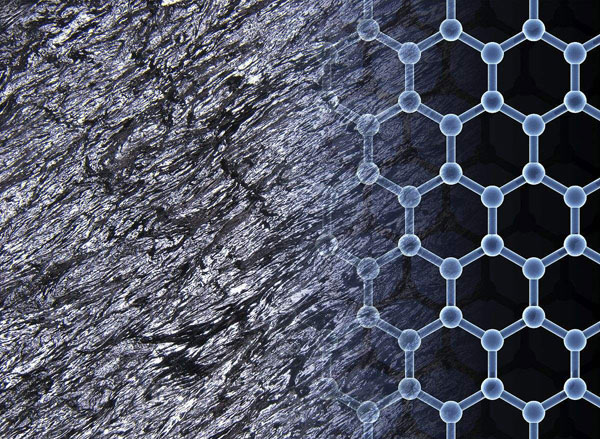
Graphene is a two-dimensional crystal composed of carbon atoms separated from graphite material, with only one layer of atomic thickness. It is currently the thinnest and strongest material in nature, with a fracture strength 200 times higher than the best steel. At the same time, it has good elasticity, with a tensile amplitude of up to 20% of its own size. However, graphene is difficult to produce a certain product as a single raw material, and its outstanding characteristics are mainly utilized to composite with other material systems, thereby obtaining new composite materials with excellent properties.
Graphene loaded composite material: A composite material obtained by introducing a second component on the surface of graphene and performing epitaxial extension on its surface.
Graphene wrapped composite material: The composite material obtained by wrapping the second component with graphene sheets can more effectively prevent the polymerization of the second component.
Graphene embedded composite material: A composite material obtained by fully dispersing graphene nanosheets as fillers in the matrix phase of the second component. Among them, the matrix phase can be composed of nanomaterials or bulk materials.
Layered composite materials based on graphene: formed by alternately stacking the second component and graphene sheets, this structure can increase the contact area between graphene and the second component, and facilitate the generation, transmission, and separation of electrons.
Classification of Graphene based Composite Materials
Graphene has many excellent properties, such as good electrical and thermal conductivity, good toughness, large specific surface area, etc. These properties make graphene based composite materials exhibit many outstanding characteristics. If graphene is used as a carrier to load nanoparticles, the catalytic and conductive properties of these particles can be improved; By utilizing the good toughness of graphene and adding it to polymers, the mechanical and electrical properties of polymer materials can be improved. According to the different second components, graphene composite materials can be divided into graphene nanoparticle composite materials, graphene polymer composite materials, and graphene carbon based composite materials.
The unique physical and chemical properties of nanoparticles have aroused great interest among nanoscience workers, but finding suitable carriers has become a challenge for the widespread application of nanoparticles. Compared with other carbon materials such as carbon nanotubes and fullerenes, graphene exhibits excellent physical and chemical properties such as electrical and optical properties, as well as lower preparation costs, making it a potential carrier for nanoparticles. Due to the van der Waals forces between layers, graphene often exhibits irreversible agglomeration, and the nanoparticles present between graphene layers serve to separate adjacent graphene layers and prevent agglomeration. In recent years, people have creatively combined graphene with nanoparticles, forming a new research field.
Graphene polymer composite material
There have been many reports on carbon based materials polymer composites before, especially research based on carbon nanowires, carbon nanotubes, and fullerene polymer composites. As a unique member of the carbon material family, graphene can also be used as an additive or carrier to composite with polymers. Graphene has significant application value in improving the thermal, mechanical, and electrical properties of polymers due to its unique structure and properties.
Graphene carbon based composite materials
Graphene can not only be combined with nanoparticles and polymers, but also assembled with other carbon based materials (carbon nanotubes, fullerenes, etc.) to form composite materials. These carbon based materials can be combined with each other to exhibit some superior properties.
Application of Graphene Composite Materials
Application in the field of catalysis
Due to its excellent conductivity, thermal conductivity, and structural stability, as well as its ability to modify and support metal catalysts, graphene based catalysts possess many unique catalytic activities.
Application in the field of electrochemistry
In order to obtain high specific capacitance supercapacitors, some research groups have designed and synthesized various graphene composite materials and applied them to electrode materials, such as polyaniline/graphene, MnO2/graphene, etc. However, graphene is prone to agglomeration and cannot be effectively utilized, which is also a challenge for its widespread application in the field of electrochemistry.
Application in the field of biomedicine
Partial double bonds of graphene are oxidized and converted into graphene oxide, which carries hydrophilic functional groups such as hydroxyl, carboxyl, epoxy, carbonyl, etc., allowing graphene oxide to exist stably in aqueous or physiological solutions with high water solubility, and is expected to be suitable for intravenous injection like a solution; In addition, graphene also has the characteristics of low toxicity and large specific surface area, and has potential application value in drug carriers. At present, the application of graphene composite materials in the field of biomedicine has disadvantages such as limited drug loading types and small cure range. Its loaded anticancer drugs mainly include doxorubicin hydrochloride, tamoxifen citrate, and camptothecin. In the future, graphene composites can be applied to deeper levels such as protein and gene drug targeted transportation and treatment.
Application in the field of energetic materials
Explosives are irreplaceable in various fields such as national defense and civilian use, so their safety is very important, as they must exist stably and be easy to detect. Graphene, on the other hand, has a certain degree of insensitivity and electrical and thermal conductivity, and has certain application value in the field of energetic materials. Currently, it is mainly reflected in explosive sensors and coating desensitization.