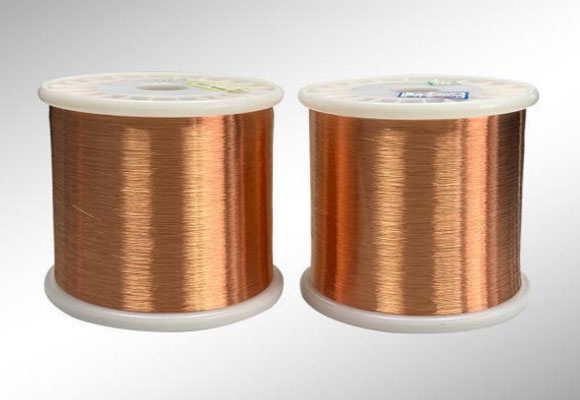
On the basis of traditional electromagnetic wires, graphene aluminum based new materials are used to modify them with the excellent properties of graphene, effectively improving the conductivity and thermal conductivity of electromagnetic wires, reducing resistance, reducing energy loss, and improving the efficiency and reliability of electromagnetic equipment. It is mainly used in the manufacturing of electrical equipment such as motor windings and transformers. The graphene composite modified enameled wire project can save 30% -50% of costs for manufacturers using motors, and is also a necessary product for motors. Currently, the graphene composite enameled wire project is the only and first enterprise in China to replace the copper market with graphene enameled wire. The usage effect is excellent.
Comparison of all data between graphene composite enameled wire and copper enameled wire on a year-on-year basis: 0.56-0.556
|
Comparison items
|
Graphene composite enameled wire (aluminum based)
|
enameled wire
|
Analysis of the advantages of graphene composite enameled wire
|
|
Execution standards |
GB/T 6109.10-2008 (155 grade direct welded polyurethane enameled copper round wire) GB/T 23312.1-2009 (enameled aluminum round winding wire) |
GB/T 6109.5-2008/IEC60317-8:1997 (180 grade polyester imine enameled copper round wire) |
Aluminum based materials combined with graphene technology meet the standards for medium temperature scenarios, filling the key performance gap for material substitution. |
|
Conductor diameter/outer diameter |
导体直径:0.561mm 漆膜厚度:0.059mm
外径:0.620mm |
导体直径:0.556mm 漆膜厚度:0.065mm 外径:0.621mm |
The outer diameter is similar, and the lightweight advantage of aluminum based materials is significant for equivalent applications. |
|
Conductor resistance (20 ℃) |
0.1074 Ω/m |
0.07035 Ω/m |
Copper has better conductivity, but the electrical resistivity of aluminum based composite materials
(about 0.1074 Ω/m) is superior to pure aluminum (theoretical value of about 0.148 Ω/m), approaching 70% of copper. During use, due to the natural properties of graphene, it is possible to achieve the same level at the same ratio, with a wire diameter amplification of 1.1.
|
|
Mechanical properties |
Tensile strength: 102 N/mm2 Elongation: 28% Resilience: 32 ° |
Tensile strength: Copper substrate about 200-400 N/mm (2 not directly tested) Elongation: 34% Resilience: 36 ° |
Although the mechanical strength of aluminum based composite materials is lower than that of copper, they have
Meet the requirements for medium temperature applications (standard requirement ≥ 90N/mm2).
|
|
Scratch resistance performance |
Minimum scratch force:>7.68 N (standard requirement ≥ 3.55 N) |
Minimum scratch force: 9.92 N (standard requirement ≥ 6.50 N) |
Copper paint film has better scratch resistance, but the scratch force of aluminum based composite materials far exceeds the standard requirements (exceeding the standard value by 116%). |
|
breakdown voltage |
Room temperature breakdown voltage: 13383 V (average) (standard requirement ≥ 4800 V) |
Room temperature breakdown voltage: 14300 V (maximum) (standard requirement ≥ 4600 V) |
Copper has a higher breakdown voltage, but the breakdown voltage of aluminum based composite materials is more than 2.5 times that of pure aluminum wire (ordinary aluminum wire usually<5000 V). |
|
Thermal performance |
Thermal shock (175 ℃): The paint layer has not cracked, softened, and broken down (200 ℃): No breakdown |
Thermal shock (200 ℃): The paint layer has not cracked, softened, and broken down (300 ℃): No breakdown |
Copper has better high temperature resistance (180 level standard), but aluminum based composite materials have outstanding stability at 155 ℃ and are suitable for medium temperature scenarios. |
|
Weight and Cost |
Material density: 2.7 g/cm3 (only 30% of copper) Cost: about 1/3 of copper |
Material density: 8.96 g/cm3 Cost: high |
Lightweight advantages are significant, suitable for weight sensitive scenarios such as new energy vehicles and drones; Reduce costs by over 60%. |
|
Applicable scenarios |
Medium temperature scenario (155 levels) - New energy vehicle motor winding - Consumer electronics internal cables - Industrial pumps and home appliances |
High temperature scenario (Class 180) - High voltage transformer - Industrial motor - High temperature environment equipment |
In the medium temperature field, it can replace copper wire and has the advantages of lightweight and low cost. |
|
notes |
1.Graphene technology enhances the conductivity and scratch resistance of aluminum based materials.
2. The breakdown voltage is significantly better than that of ordinary aluminum wire, approaching 85% of that of copper.
3. Lightweight design can reduce equipment energy consumption (such as improving electric vehicle range).
4. Meet environmental requirements (abundant aluminum resources, with a recycling rate of up to 95%).
|
1. Copper's conductivity and high temperature resistance remain the industry benchmark.
2. High density and cost limit its application in lightweight scenarios.
3. Suitable for high-end fields with extremely high performance requirements and sufficient budget.
|
Graphene composite aluminum based materials have disruptive potential in terms of lightweight, cost, and environmental friendliness. In the future, they can be optimized through technology. Currently, the development of oriented arrangement of graphene is underway to achieve revolutionary creation. Further replace copper wire with graphene doping ratio and magnetic enhancement. |
Two reports with the same proportional wire diameter: both from the cable institute, original copies can be provided.
Performance balance: Graphene composite aluminum based enameled wire has approached 70% -85% of copper wire performance in core indicators such as conductivity, mechanical strength, and scratch resistance, and far exceeds the requirements of aluminum wire standards.
Alternative scenarios: Copper wire can be fully replaced in areas with medium temperature (≤ 155 ℃) and lightweight demand (such as new energy vehicles and consumer electronics), reducing overall costs by more than 60%.
Technological potential: By optimizing graphene doping processes or developing materials with higher temperature resistance, it can be further expanded to high-temperature applications in the future.
There are too many cases, provide usage reports from several large manufacturers.
The following is a real manufacturer usage report
Report 1: Comprehensive Test Chart
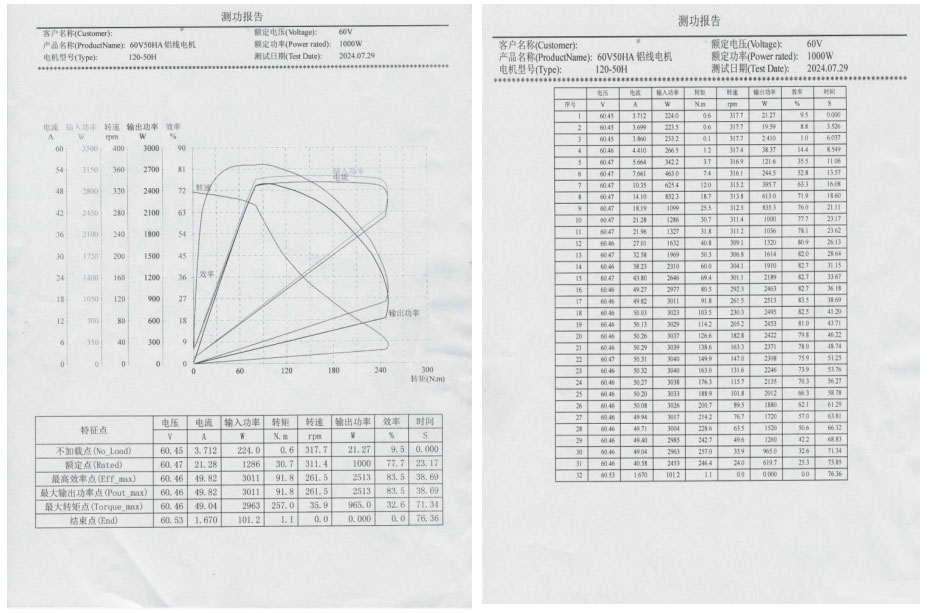
According to the above report from the tricycle factory, the data of graphene composite enameled wire and copper enameled wire maintain their advantages, and their application effects and data are reflected in various indicators.
Report 2: Durability Test
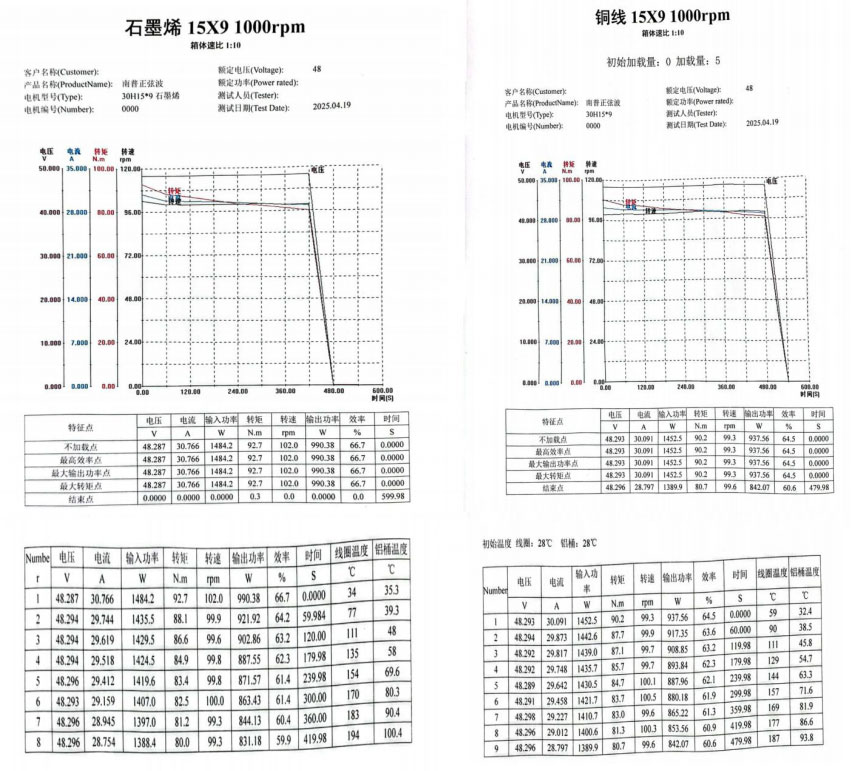
From the above two reports, under the same conditions and environment, graphene enameled wire has a slight advantage in power, torque, and time, while the difference in speed and temperature rise is only about 0.1, which can completely replace the application of copper enameled wire.
Report 3: Destructive Testing
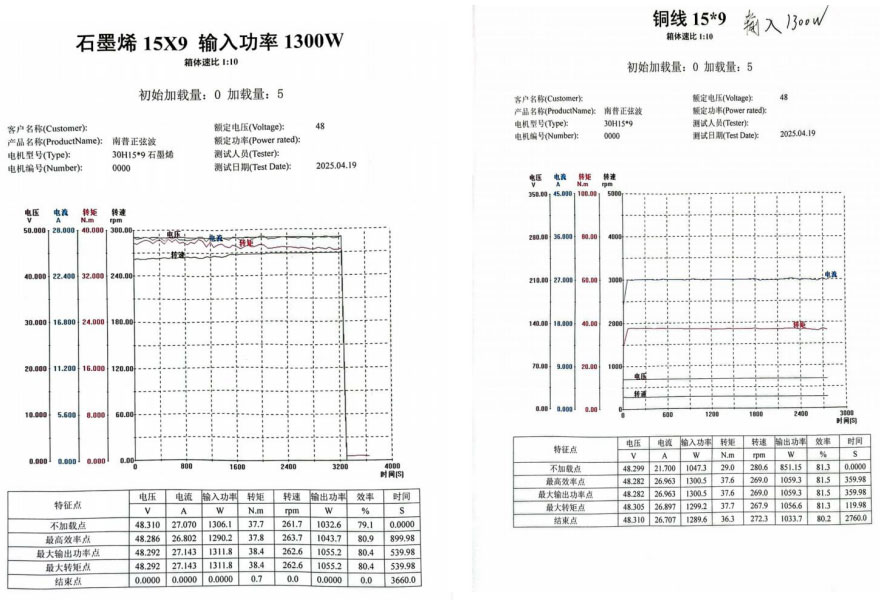
In a destructive test conducted by a leading enterprise in a certain industry, the advantages of graphene composite enameled wire as a new material were further demonstrated, surpassing the application of copper enameled wire in terms of torque, output power, efficiency, and time.
More industry testing reports are available in their original form.
|